





| Commercial market – data from Carter Jonas indicates an uneven recovery in investment volumes, below levels seen in Q4 2025 | Logistics market – according to Knight Frank, the sector saw £1.64bn in transactions in Q1, 5% down on Q1 last year | Infrastructure capital – a CBRE report highlights that this is an increasingly important driver of commercial real estate investment |
Commercial market update
The latest Commercial Market Outlook from Carter Jonas offers an insight into current market trends. The data indicates an uneven recovery in investment volumes, with £10.7bn traded in Q1 2026 – below the higher levels seen in Q4 2025 but slightly above the total for Q1 2025.
The report also notes that transaction activity is increasingly deal-specific, with the office and retail sectors proving to be more resilient than expected. Return-to-office mandates have led to a shortage of prime supply in many key city centre markets as demand continues for high-quality office spaces. This has supported annual rental growth of 3% in April 2026 for all UK offices, according to the MSCI Monthly Index.
The industrial market saw a softer quarter, as demand continues to be shaped by a variety of economic, political and technological factors. More retailers are expected to outsource their operations to third-party logistics (3PLs), which will continue to affect supply chains.
Logistics market overview
A recent report from Knight Frank shows how the logistics market is faring so far this year. The sector saw £1.64bn in transactions in Q1 this year, which is 5% lower than the same period last year.
The outbreak of war in the Middle East has caused a rise in swap rates and alternative asset yields, so investors are now scrutinising deals more carefully. However, they will likely be under pressure to deploy capital and there have still been some significant transactions in Q2.
Occupier take-up reached 9.0 million sq ft in Q1, which is in line with the total for Q4 2025. Meanwhile, the vacancy rate increased to 8.3% due to lower quality second-hand units returning to the market. At the end of Q1, there was 8.3 million sq ft of speculative space under construction across 56 units – this is expected to remain suppressed due to inflationary pressures.
The rise of infrastructure capital
A report from CBRE has highlighted that infrastructure capital has become an increasingly important driver of commercial real estate investment.
In 2025, £29.9bn was invested in the UK Alternative and Living sectors, which includes £13bn into Healthcare. Infrastructure capital accounted for 44% of investment into real estate last year, a sharp increase from 15% in 2016. This trend is expected to continue, with a survey of institutional investors across the globe finding that 98% were expecting to either increase their allocations to infrastructure or keep them the same over the next 12 months.
CBRE notes that investors may be attracted to infrastructure as it can be seen as a more stable asset class than others, as income is often underpinned by long-term government contracts. However, these sectors are also more reliant on government funding which can affect long-term income assumptions. Plus, there can be greater operational complexity, which may impact returns.
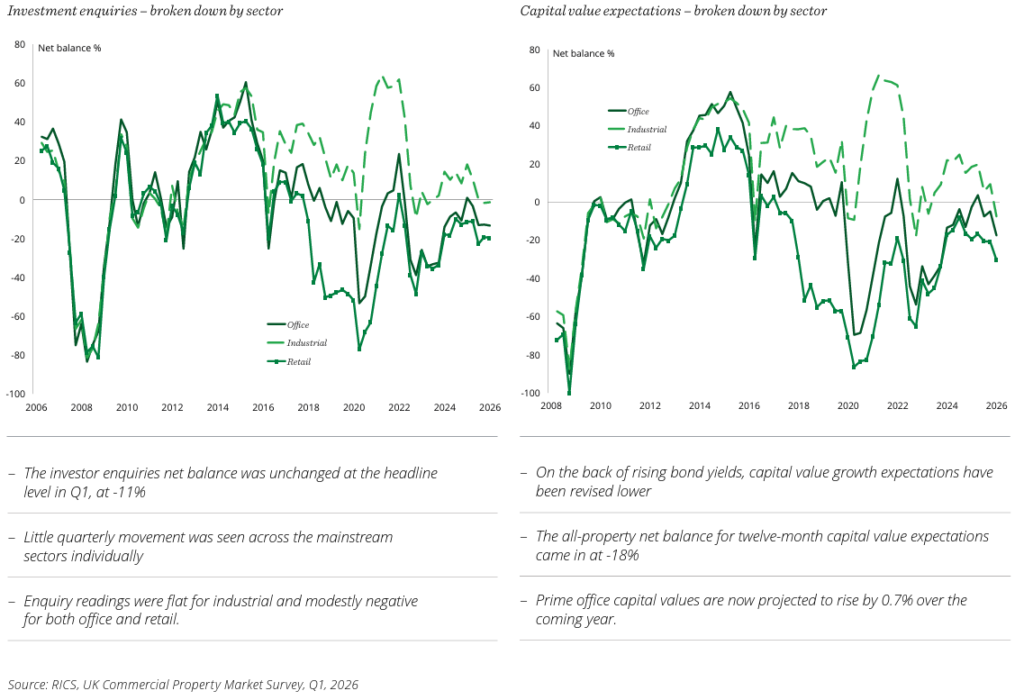
Commercial property outlook
French investors in the Scottish market
French investors are increasingly attracted to the Scottish market, purchasing £183m of commercial property since November 2025.
The research from Knight Frank found that, since 2024, French buyers have purchased over £450m of Scottish property, making them one of the most active international investors in this market. The Société Civile de Placement Immobiliers accounted for nearly half of these transactions, including 40 Princes Street in Edinburgh and 3T Survivex training facility in Aberdeen.
According to Douglas Binnie at Knight Frank Glasgow, even if French investors have not successfully bought an asset, they have often been an underbidder. He explained, “A big part of the attraction is the value on offer in Scotland, with yields higher than other parts of the UK and Europe. And that is especially true in Aberdeen, where buyer and seller expectations are comparatively aligned and you can pick up good quality assets on double-digit returns.”
All details are correct at the time of writing (17 June 2026)
It is important to take professional advice before making any decision relating to your personal finances. Information within this document is based on our current understanding and can be subject to change without notice and the accuracy and completeness of the information cannot be guaranteed. It does not provide individual tailored investment advice and is for guidance only. Some rules may vary in different parts of the UK.