





| Commercial property update – London captured the largest regional share of investment by the end of August | Residential Market Survey – the housing market is stabilising further with buyer demand and agreed sales showing improvement | Industrial and logistics sector – Demand in the sector still being driven by ecommerce growth and supply chain resilience |
Commercial property market update
Colliers’ latest report offers an update on the UK commercial property market.
By the end of August, £24.3bn investment had been completed year-to-date (YTD), up slightly on 2025. London captured the largest regional share, representing £9.2bn of activity. International investors accounted for nearly half (46%) of all transaction volumes.
Retail investment slowed from £490m in June to £350m in July, sitting significantly below the five-year monthly average of £660m. However, consumer confidence rose to -17 as retail rental growth accelerated at the fastest pace in seven months. The industrial sector had a strong month, with investment volumes rising to £1.2bn in July. Meanwhile, hotel investment totalled £2.8bn YTD, which is more than double the levels of the same period in 2025.
In London, office take-up increased to 2.8m sq. ft in Q2, about 4% higher than the ten-year average. Grade A buildings continue to be in high demand, accounting for 76% of leasing activity.
Industrial and logistics
A report from Knight Frank notes that the ‘UK industrial and logistics sector is entering a new phase.’
Demand in the sector is still driven by ecommerce growth and supply chain resilience; however, activity is increasingly aligned with complex factors, such as government policy decisions and international trade flows. For example, the National Planning Policy Framework specifically recognises the importance of freight and logistics, helping it to be viewed as strategic infrastructure, thus boosting demand and planning prospects.
Also, Chinese ecommerce operators have become one of the most important sources of occupier demand. They have demonstrated interest in a broad range of markets beyond the traditional ‘Golden Triangle’ distribution hubs. Recent transactions include bonded warehouse facilities around London and last-mile delivery depots in Leeds.
Knight Frank notes that ‘demand is becoming increasingly concentrated around key import gateways, urban fulfilment markets and locations capable of supporting modern, technology-enabled supply chains.’
Market outlook
2026 has been clouded by political and economic uncertainty, but Carter Jonas notes that the new Prime Minister may offer some stability for the commercial property market.
As the UK awaits Chancellor John Healey’s first Budget, many investors will be looking for policy certainty to boost their confidence. In the coming months, transaction times are likely to lengthen after the summer holiday period; however, this is due to timing rather than weak appetite. Carter Jonas notes that investors are ‘continuing to target well-priced opportunities across sectors supported by strong occupational fundamentals and resilient income characteristics.’
As we head into 2027, the outlook may be slightly more optimistic due to stabilised pricing and improved financing conditions. The industrial and logistics market is supported by strong occupier demand, while the retail sector is experiencing renewed investor interest. The office market is ‘polarised’, with prime ESG-compliant space outperforming other buildings.
RICS Residential Market Survey
The latest Royal Institution of Chartered Surveyors’ (RICS) UK Residential Market Survey indicates that the housing market is stabilising further.
The report shows that buyer demand and agreed sales were still in negative territory in August, but both showed some improvement. The net balance for new buyer enquiries increased for the fifth consecutive month to -19%, marking the least negative reading since January. Sales agreed recorded a similar net balance of -17%, up significantly from -38% in April.
Expectations for sales over the next three months moved closer to neutral territory, rising from -13% in July to -3% in August. The 12-month outlook also improved moderately from +3% to +6%.
In the lettings market, demand continues to outweigh supply; monthly tenant demand recorded a net balance of +18%, while landlord instructions stood at -14%. A net balance of +44% of respondents expects rents to rise over the next three months, up from +33% in July.
Mortgage rates affecting sales
The latest report from Savills shows that higher mortgage rates have impacted sales activity.
In July, mortgage approvals were 16% below the 2017-19 average and the lowest level since December 2023. Sales agreed were also down 6% in August when compared with the pre-pandemic norm.
Completed transactions were 2% higher than the 2017-19 average in July due to a stronger market earlier in the year.
It is expected that transactions will drop in the coming months due to weaker mortgage and sales activity. However, Zoopla reported that buyer searches were up 7% in August. Savills notes that ‘when mortgage rates do fall, there is likely to be a degree of pent-up demand in the market.’
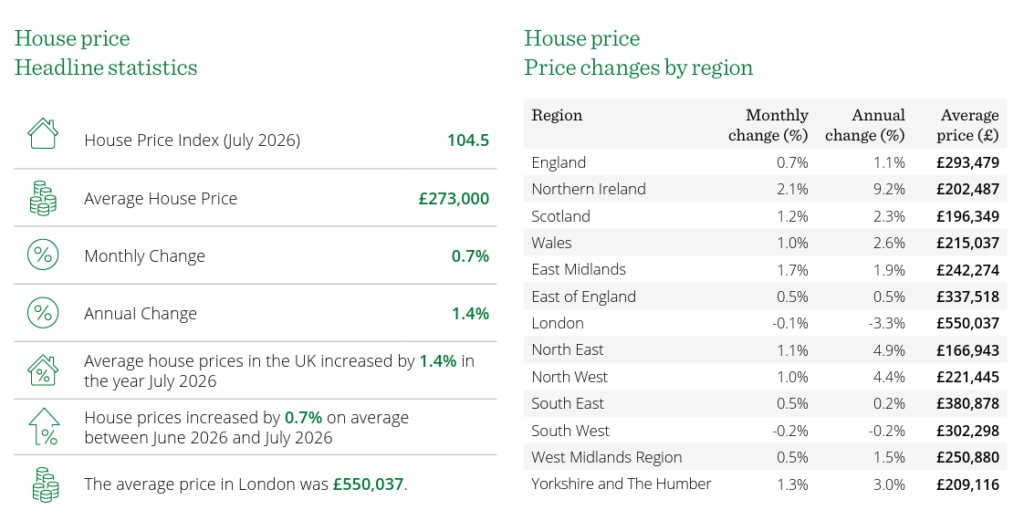
Scotland and the North West continue to lead the way when it comes to house price growth. Localised data indicates East Dunbartonshire (10.9%) recorded the strongest growth in May, while Kensington and Chelsea (-9.1%) saw the slowest growth.
Landlords’ incomes rise
The average landlord’s income has increased over the last year, according to analysis by Rushbrook.
In Q1 2026, the average UK landlord portfolio generated £88,454 in gross rental income, representing a 22.9% increase compared with the previous year. The average landlord owns 7.3 properties, with a combined estimated value of £1.7m.
These figures have remained unchanged over the last year, showing that the increase in rental income has generally not been driven by landlords expanding their portfolios. Instead, the rise is due to higher rents, with estimated rental income increasing from £9,860 to £12,117 per property.
However, estimated buy-to-let mortgage borrowing has also increased by 14.6% over the year and landlords need to account for the ongoing cost of managing properties, which is typically around £139 per month per property.
It is important to take professional advice before making any decision relating to your personal finances. Information within this document is based on our current understanding and can be subject to change without notice and the accuracy and completeness of the information cannot be guaranteed. It does not provide individual tailored investment advice and is for guidance only. Some rules may vary in different parts of the UK.
All details are correct at the time of writing (16 September 2026)